Showing posts with label exhaustion. Show all posts

Sunday, January 24, 2016

No Time Like the Present

I have been living in a delusion, a fairly common one, but one to which I had thought myself immune. I suppose it is in the nature of delusion for me to believe this: others may be prone to this false belief, but not me. Heaven forbid.

The delusion is this: eventually things will even out at work and I will finally be able to just work my 40 hours. Everything will henceforth go smoothly, none of my employees will resign, or get sick, or become pregnant, or move to Denver. The way to ensure that this evening out happens (so goes the delusion) is for me to work 50 or 60 hours a week now. I will reap the benefits of all that peace later.

This is bullshit.

The realization of just how far down this particular rabbit hole I had gone arose from the recognition of the many mornings I have been skipping my meditation to go in early to work. This is just nuts. One of the pillars of my system of belief and my regimen of self-care is a steady diet of daily meditation, but I have not been getting that. And I have been feeling its lack.

The reason why this fantasy equilibrium can never come to pass (I just had an epiphany about this today) is that I am confusing situational chaos with constitutional and institutional chaos. Up until this moment (I can just barely admit, even to myself, how long it took) I have been operating on the belief that if I can just handle the current situation adequately, smooth sailing is inevitable. The basic problem with this way of thinking (it seems obvious now) is that the problem is not the situation. First of all, it is in the nature of my work (it's constitution) that there will always be chaos. I work in a bureaucracy, in health care, with many moving parts, and even more egos to clash together. Not to mention the basic fact in any workplace with greater than one employee--there will always be inequities in the way people work, how hard they work, whether or not they come to work consistently, their propensity to illness (and "illness"), the likelihood of a move to Denver, and on and on. It is also in the nature of most institutions to ask of their employees just a bit more than each has the ability to give, and when they succeed in supplying that little bit more, to ask for a little bit more yet. With the increased emphasis on "productivity" (which, thankfully, we do not yet have to contend, at least not in any measurable form), I have seen many workers devote hundreds of unpaid hours a year to fulfill these unrealistic requirements, which are then steadily ratcheted up.

I am now, it becomes clear, a practitioner of presenteeism, a fascinating word I heard for the first time just the other day, the definition of which is "the practice of coming to work when ill or tired, or remaining at work for extended hours unnecessarily". Because of where I work, I do not go
to work sick, but the other parts of the definition fit me to a tee. Of course, one could argue about the definition of "unnecessary", but to trust that delineation to me would be like trusting an addict with just how much heroin is a good idea. Thus, the 40 hour limit, the built-in definition of a sane work week.

So, here is my public vow: in June I turn 60. For years I had been saying that at 60 I was going to take a 50% position, work only half time. When I took my current supervisory job, this became unrealistic, but I vow this instead: when I turn 60, I will no longer work any more than an average of 40 hours a week. (I say "average" not as a hedge, but because my plan is to work eight nine-hour shifts and one eight-hour shift every two weeks, taking the tenth day off). As part of this vow, I am going to inform my employers and employees of this. And now I am telling you. And my wife. And everyone who will listen. And I ask that you all hold me to it.

What I can get done in 40 hours, I will get done. What I cannot, I will not. In all likelihood, it will remain undone. And it probably (sadly) won't make all that much difference. That, too, is part of the delusion, isn't it, that my work is so extraordinarily valuable that the place would FALL APART if I worked less than 50 hours a week. How grandiose is that?

Maybe I'll see you in the park. Or the coffee shop. The movie theater. A museum. Anywhere, anywhere, ANYWHERE other than work. I promise.

Sunday, October 12, 2014

Uh oh

I don't have much time or energy for a long post today. I am feeling a little under the weather (an interesting phrase, that). I don't know if I am actually ill or just exhausted.

The honeymoon is clearly over between me and my job and now I enter into the long slog of doing the right thing, or trying to. Which is not to say I am sad doing what I am. I still think I can be of service to my patients, my workers, my coworkers, and the whole institution. But it sure does seem like no one is setting out to make it easy to do so.

I am acutely aware of who might read this blog (I post the link on Facebook, after all), so I don't want to dig myself a hole I might fall into down the road. Let me just say that the predominant characteristic of most people I encounter in a day's work is self-centered self-interest. This shouldn't come as any surprise; watching out for Number One has been the rallying cry of several generations now. Never mind that this is not a recipe for happiness or even contentment. It seems to be irresistible to think, "If I don't take care of me, there sure as hell isn't anyone else who will. So, watch out, world! If I get my needs met, you might get some of me, my loyalty, my effort, my understanding, my compassion, my heart. But if Mama ain't happy, ain't nobody happy." Something like that.

This is the road to misery. I am convinced of this. But unless I remind myself constantly of this, the temptation is to be reactive and think, "Well, then, to hell with you, too!" I can't, I must not.

A Bodhisattva is (loosely speaking) a person who has dedicated his or her life to becoming enlightened for the purpose of being helpful to others. Even in the study of the Dharma it is far too easy to fall into the trap of selfish motivations, the goal-oriented, personal quest for Betterment or Freedom. The Buddha was very clear, though, that we are only as free individually as the least free among us. Because we are wholly interdependent, it is impossible for your personal freedom to be genuine if it is purchased with shackles being placed on me.

I have dedicated my life to the path of the Bodhisattva. Which is not to say I am anywhere near the point of enlightenment, believe me. But what it does mean is that I have vowed to open my heart and open my heart and open my heart. No matter what. There is no efficacious response to brutality other than kindness. There is no better response to selfishness than selflessness. There is nothing to pit against hate that is not love. I can only walk the path and hope for the best.

And, hey, sometimes I get to go away with friends on a long weekend and take photos like this one. Life can't be all bad when there are places like this.

Saturday, March 15, 2014

I am not I

I recently read a very good book about Israel. I won't go into that whole mess here, but if you are interested in what I have to say about the book, you can see my review here.

I have not been meditating as much as I would like recently. Life has become very busy.

Our bodies are entirely dependent on the health of our microbiome. There is a very good article in the New York Times about this, and about how antibiotics—those we take and perhaps those in our food—might be at least part of the cause of the obesity epidemic in the United States.

I had to fast for 12 hours Thursday night and Friday morning so I could have my blood drawn Friday morning.

I have become more and more amazed how much time, thought, and effort must go into the maintenance of a single human life.

What in the world do all these things have to do with one another? Well you might ask.

The Buddha spoke of interdependence as being the core of all his teachings. I remember when one of my teachers first introduced this topic by saying flatly, "You don't exist". I can easily challenge this statement, naturally. I can hit you in the head and then ask you why your head hurts if I don't exist. But that, of course, is not what my teacher meant. The Buddha's philosophy is unique and challenging in many ways, but this may be where it is most difficult and by far the most elegant. Because it's true: we don't exist. Not in any substantial or lasting way. And we cannot exist alone.

The odd thing is not the assertion that we do not exist as discrete beings but that we have ever thought we did. From the very start of our earliest precursors to this very day we are entirely dependent on plants to supply the atmosphere with oxygen, to take just one example. We would never have evolved as these particular beings had there not been plants. Period. We might have become some sort of nitrogen-processing organisms, but the nature of the beings we are is predicated on our ability to use oxygen and the presence of that oxygen is predicated on the existence of other beings. So, too, with every other constituent of our bodies. We are the product of stars, comets, bacteria, slime mold, flowers, and dinosaurs. The blood of emperors and slaves flows through me.

When we war with each other, when we claim territory as "ours" and not "theirs", we have entirely lost sight of our interdependence. Entirely aside from my opinion about the disposition of Palestine and the right of existence for Israel, not to mention the Russian claim to hegemony over Ukraine, when I have sufficient perspective to do so, I find myself astonished that we are still in such bellicose relation to one another. These days, it is amply evident that what will remove us from this earth is most likely either climate change or nuclear war, yet we focus on territorial disputes and health insurance. Never has it been so evident that we are interdependent than right now. If we do not take concerted and unified action to solve both of these problems, we won't last another generation.

My meditation practice is limited by the time I have available to sleep, which is impacted by the new position I have at work, which came to pass because of an injury to a co-worker. A relationship that ended years ago caused enough disruption in a girl's life that her mother, another of my co-workers, had to quit her job to spend more time with her daughter. The cruelty of a father, the coldness of a mother, rejection by a lover, failures in third grade and successes in high school—all of these influence the people who come to work where I work and limit how effectively they can work and therefore how much time I must spend there and therefore how much sleep I get and therefore how much I can meditate. Interdependence. In this context, I am interdependent with people who died before I was born and others I will never meet.

Need I say more about our microbiome (the internal microbiotic environment of our bodies, our gut in particular)? We are entirely interdependent with these billions of beasties. We would not have evolved to this state without them and would die overnight if they ceased to exist.

I take for granted how easily I am able to maintain this body's health. I also assume that my nice, healthy mind can function independent of what else goes on. Nothing like a 12-hour fast to put the lie to assumptions like these. I was irritable, could not think well, was fumbling and clumsy. It is astonishing how quickly we begin to fall apart without food. And from whence does this food come? I didn't grow it, harvest it, process it, ship it, stock it, or sell it. Literally hundreds of interlocking actions go into my breakfast. And if you consider that each being in the chain of my breakfast (cow, farmers, soil organisms, harvesters, processors, packagers, truckers, stockers, clerks, managers, executives, maintenance crews to keep all the machines and processes running, mechanics, oil rig workers, fuel processors and sellers, water engineers, research chemists, flatware and bowl manufacturers, and on and on) has its own interlocking chains of interdependence, then literally millions—billions, perhaps—of beings provide me with my breakfast, without which I am am mess before I get my blood drawn at 8:00 A.M.

But the Buddha's message, you will recall, was not one of chastisement; he was not trying to remind us where we come up short. His was and is a philosophy of freedom. He taught first of all about suffering, but only to teach the end of suffering. And the end of suffering is the end of delusion. All we must do is cease believing that which isn't so. And why not? Our believing in untruths does not make them exist—they still don't. So why not give them up?

That's the amazing thing about the Buddha's teachings: we have the choice to be entirely free today, right now, in this moment, and forever. We can choose that right now. Why do we not? Because we have so thoroughly incorporated into our consciousness the lies: that we are independent, free-standing, individual human beings with no need of anything or anyone else, nonetheless the whole of existence. We believe the lie that the problems of the world are not our problems because they are not currently on our doorsteps (they will be). We believe that the suffering of others is separate from our suffering. We believe that we deserve only good things and that when bad things happen something has gone wrong. And we believe that biggest lie of all—that we exist. But freedom awaits those of us who know that our molecules are only ours for the briefest of time, that we constantly interchange who we are with the rest of the world and they with us. We have no choice in the matter; it is who we are. But we do have the choice of whether or not we suffer.

Saturday, June 15, 2013

Thaings

I pick up trash while I'm walking and occasionally come across something wonderful. Once I found a small slip of paper, on which someone (I suspect an older child) had written, "This is not going to work." In response, in a younger child's writing, was this: "It will if you THINK it will".

The other day I picked up another scrap and on it was, "Thaings I wish could have Happen." There was nothing on the list, just that title. Don't we live much of our lives in pondering thaings we wish could have happen? Along with those we wish hadn't happened and others we dream still may happen. The same thing was happening in the Buddha's world 2500 years ago. Because we are planning animals (one of the few advantages we have over our predators) and can analyze our past actions and make corrections ("Almost got eaten that time, better revise my hunting technique!"), this kind of thinking is hardwired into us. Unfortunately, if not used for survival, these ways of using our minds lead directly and inevitably to suffering, which the Buddha defined as everything that is not in this moment.

After all, we know what the ephemerality of the moment is. I was just speaking with a friend today about this: who we thought we would be ten years ago isn't even close to today's reality, which means we have absolutely no idea who (or where or how) we will be ten years from now. Dead? King of the World? Who knows? Who cares? Much better to tell that outrageous fellow chattering away in my head to take a break so I can enjoy the moment in which I am existing instead of pondering and kvetching about future and past, that's what I think.

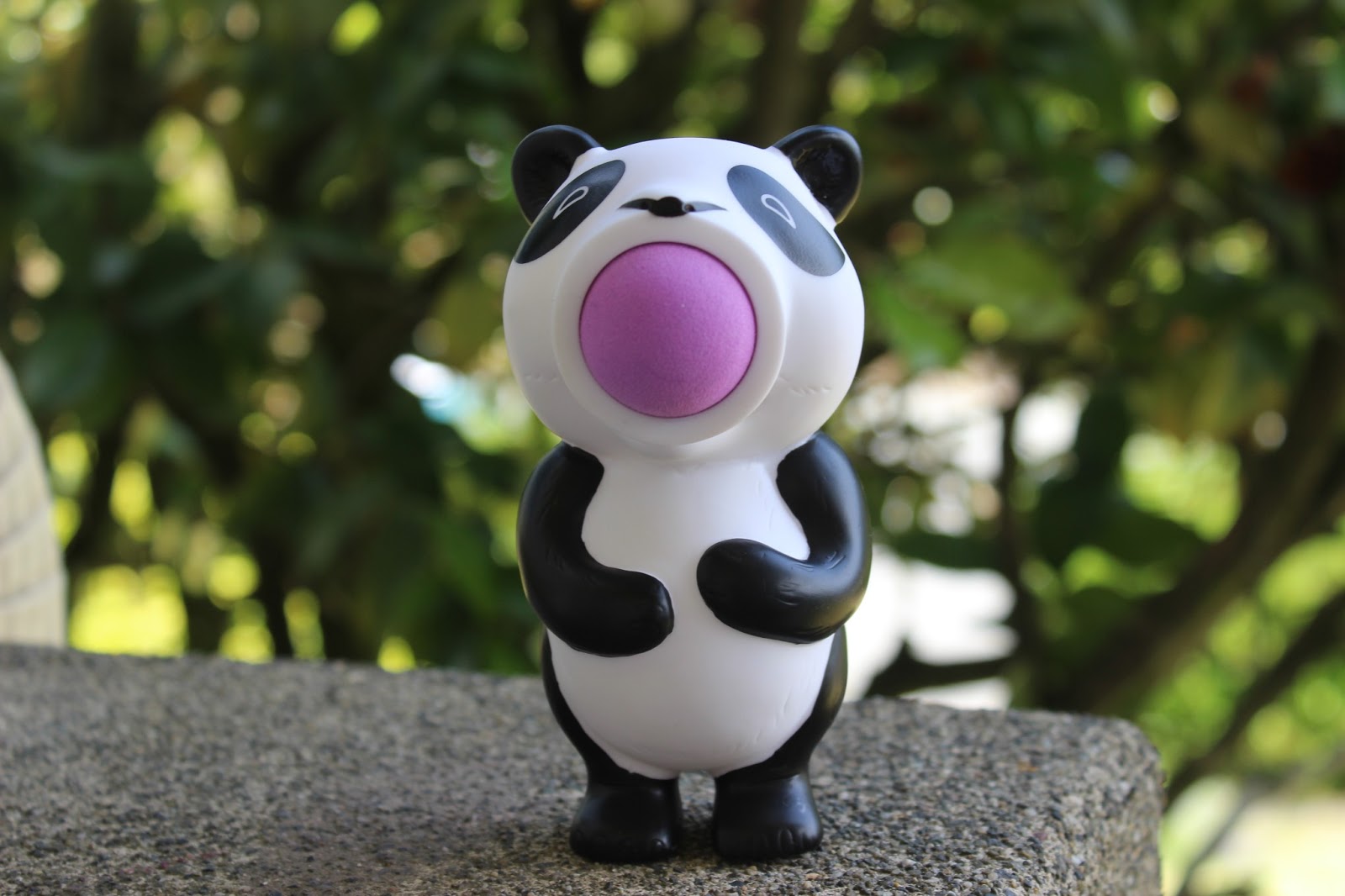
Had a birthday. I am 57. I don't feel that old, except first thing in the morning, when I feel 157. I had a good birthday week. I didn't do anything all that exciting, but that's fine with me—exciting is exhausting! Among other things, I got a Panda Popper (he shoots that little purple ball across the room and does so with a satisfying "pop!").


I was complaining about the freezer not being a freezer last week, and during my birthday week (the day before my birthday, actually), that was finally fixed. Our freezer actually has frozen food in it! Imagine that!

And, best of all, we finally got our new front stairs. I paid the company who did them (and then redid them) yesterday. What a load off my mind. Here they are: Ain't they pretty?

Point being that thinking about "thaings I wish could have happen" did me absolutely no good while I was going through all that turmoil; they took care of themselves in their own good time.

I live a good life. So do you. It is enough. And more than enough. It will work if you think it will.

Sunday, February 17, 2013

Lost

Not sure where to begin. I feel so lost sometimes, as if the core if who I am gets called into question. I know I have written about this feeling a great deal lately. But this is, for me, the most profound of all experiences, this contrast between my reality as a being that does, after all, exist in some form (however ephemeral)  and the truth of the constantly dissolving, crumbling nature of that beingness.

Does this sound very foreign and strange? Contradictory and a little nuts? Yeah, it feels that way to me too, quite often. Yet it also feels more entirely truthful than the next largest truths there are. I want for things to be certain and comfortable, always. Yet because I desire the certainty, I cannot have the comfort; there's a Catch-22 for you! It's as if I had hitched my happiness to the sun always shining—at least once a day for half the day (or thereabouts) my hopes would be dashed.

My parents are old and becoming gradually less able to care for themselves. Contemplation of the inevitability of aging, decay, and death is one of the Buddha's primary instructions to us, an entry point to the holiest of understandings, that all things are of this nature, the nature to arise and pass away. We can understand this intellectually with great profundity, yet have no capacity to face the reality of it in the form of our own illness or injury, or the slow diminution that is the inexorable march toward the end of life as it is experienced by those we love. Because it is deeply uncomfortable, of course. Death is one thing, but gradual loss is quite another. Here's the Buddha's take on this, though: suffering is my resistance to the truth; the experience itself is entirely neutral.

Easy for him to say.

There is another factor in this situation with my parents: we cannot afford to provide them with everything that might make this journey as comfortable as it could be. This precipitates us into hard choices and difficult conversations no one wishes to contemplate.

So much comes down to humility, it seems to me. In the contemplation of the great mysteries, even in thinking of the smaller ones, the minor questions, an honest survey reveals how entirely helpless I am in the face of these forces. Not merely the forces of old age, disease and death, not just the forces of nature that destroy homes and lives, not only the forces of economies and injustice and misplaced societal priorities, no, even in the contemplation of the smallest realities of my existence I am almost entirely powerless to change things. I can choose which shirt I wear today and, perhaps (if I am willing to be uncomfortable) not to wear a shirt at all. But I can choose neither the nature of the body upon which I place the shirt nor the need it feels to be clothed. I cannot willy-nilly decide to disregard decades of conditioning and wear a dashiki instead, not with any level of comfort. I must humble myself to know that I am the sum total of the causes and conditions that brought me to this point. Far from being a free agent, I am at the mercy of that which led to this time in my existence. I must, in the words of the old phrase, "dance with him what brung me".

I am tired today, without any identifiable reason. I have goals and plans and schemes, but I am tired. I probably won't do most of what I had in mind. I must listen when my body tells me to halt. I need to make myself a steward of this body and this mind in order to move forward into a deeper understanding of what it means to have a body and a mind.

There is no easy solution to my parents' situation, of course. There are complexities piled on top of complications. Also to be considered is the fact that the grooves of the relationship between my parents were first laid down over 70 years ago when they first met and have been worn and deepened every day since. We may be as logical, sensible, rational, caring, loving, and reasonable as we wish, yet this will be no proof against these well-worn patterns of love between them. Because it is love, that's clear, even when (especially when?) they bicker or disagree or grow impatient.

I began this post by saying I was lost. And I am. But lostness is the truth of our lives. It is when we consider ourselves found that we are living most in delusion, if only because even if this feeling is true it cannot last. Where I have found myself will change, I will change, and once again I will be lost. We are all wanderers in this wilderness of being alive and human. It is not easy. But it sure beats the alternative. It is enough.
Overcome any bitterness that may have come because you were not up to the magnitude of the pain entrusted to you. Like the mother of the world who carries the pain of the world in her heart, you are sharing in a certain measure of that cosmic pain, and are called upon to meet it in joy instead of self-pity.
  Pir Vilayat Khan

Monday, November 12, 2012

11,000

I just got back from a vacation to that warm-weather hotspot that's all the rage, yes, that's right, Milwaukee, Wisconsin. You just don't know what you're missing....

Well, OK, yes, you do. It was cold and wet and windy. We went there to visit Kathy's family; she has twin sisters who were turning 50 and it was very important that we go there to remind them of just how old they had become. I know, how kind of us. Of course, they are seven years younger than we are, so the force of our needling rhetoric was somewhat lacking.

And I came down with a cold almost as soon as I got there. I never know whether to blame air travel or not. I used to think it was impossible to come into contact with a cold virus on the plane and get sick the next day, my thinking being that there had to be an incubation period of at least a few days involved here. But, at one point during my copious down time (it was a pretty bad cold), I looked it up on my smartphone and even the Centers for Disease Control says that you can show symptoms in as few as 12 hours after exposure to a rhinovirus. So...who knows? I have been pretty fortunate the past few years in not getting ill too often, but I couldn't dodge it this time.

On the other hand, it was great to be forced into a supine posture and to stay there. I sat in a recliner while others worked around me (we were staying in my late mother-in-law's house and cleaning it out so it can be sold in the spring). I love to supervise the work of others. And I know I needed the rest. I sure did go through a few boxes of Kleenex, though!

**************************************************

The 11,000 of the title refers to the number of views this little blog of mine has gotten since I started a little over a year ago. I'm not bragging about that number, of course; I am acutely aware that there are many blogs that get ten times that many hits in a single day. But I find it fascinating to think so many people have at least clicked on a post to see what it's all about. Blogger keeps track of  many statistics on this stuff and it thrills me no end that among those 11,000, six were from Malaysia, eight from South Korea and 11 from India, among other places. What does someone from India make of what I have to say, I wonder? I wish a few of them wrote comments so I knew a bit more about them.

I also find it fascinating (and, frankly, a bit head scratching) to see which posts have garnered the most hits: Happy Day has gotten 99 so far, Return 56, Cafe Racer 52 and Living Without A Car an amazing 294 hits. Joyful has been looked at 334 times, Shaking Up the Snowglobe a mind-boggling 501. I note with interest that whereas Eightfold Path, Wise Action (Part I) was viewed 245 times, only 43 of those folks came back for Part II. I feel gratified that the introductory post If You're New Here has been viewed 128 times; I guess it must be helpful (though I have no idea if most of those folks took a look and then ran away as fast as they could). My very first post, No, Indeed He Wasn't, has gotten almost a third of the total number of views, 3062.

Ah, well, I know these numbers don't really mean much in the final analysis. Well, I suppose they mean something, but I'll be damned if I know what it is. People seem to be looking for things to give meaning to their lives and to bring them joy. I'm sure that many of those who came here are attracted to the idea of accepting their bodies as they are while simultaneously taking on their complex relationship to food. It is perhaps the most fascinating journey I have been on, I can say that for certain.

But where the numbers truly have little meaning is in how I intend to continue. I have only my own experience and my own perspective to guide me and to give meaning to what I write here. I have enjoyed the ride so far and intend to continue, even if this post only gets 20 hits. What the heck, that's 20 more people than usually listen to me when I'm saying something! 

Friday, July 20, 2012

Right now

I admit to struggling a bit these days. Grief has come to our house for a visit. From past experience I know it has a tendency to stay exactly as long as it feels it must (as opposed to the few minutes or so I want to face it). Kathy and I are busy and a little worn down. We have a fully committed weekend, just when I think both of us would rather hunker down and rest (it's not the kind of commitment that is really optional). I am also struggling with the fact that my friend who is dying and my parents who are aging are hundreds of miles away while I am all the way up here in the upper left-hand corner of the continental U.S. My heart feels almost literally torn. (However, today I saw a George Burns quote that made me laugh: "Happiness is having a large, close knit family...in another city". No, Mom, I don't mean it. But it's funny).

Oh, and there are stressors at work and things to do at home that don't get done and the world is a mess and my laptop...well, now, let me say something about my laptop. Does it drive anyone else crazy that tech people always blame the problems they cause (or may have caused) on the user? I am fairly certain there is a vow taken by all of them that the words, "Oops!" or "I'm sorry" or "My bad!" or (god forbid) "That was our error. Let me fix that for you right now for free" will never pass their lips. Or even, "Well, that seems unlikely, but if we broke it, we will take responsibility". Even when the issue was clearly not present before they got their mitts on my computer and is there when I get the thing back, this can never, ever be their problem. Case in point: I had some bad RAM replaced (who knows how it strays from the straight and narrow, that RAM, but somehow it went rogue, I guess) and when I tried to play a DVD a week or so later, the program didn't work. When I went in, I was told that replacing RAM has nothing to do with the DVD program. I'm not an idiot, I know this, but one must admit that the temporal proximity is a bit suspicious. The technician took great umbrage at the suggestion that anything they may have done in the process of replacing RAM could have created the problem. I have determined that this is actually a religious issue. Since God (technology) is infallible, then his priests (technicians) cannot err. And we know how well that philosophy has worked out for religion over the centuries. OK, end of rant.

These past few weeks I don't feel particularly skillful in dealing with stuff, either. Once again, it is Pema Chodron who comes to mind, reminding me that this will happen over and over again, that as soon as I feel I am on the path to fully waking up, I will stumble and fall and wind up (as she says) on the path with mud on my face. Aren't I supposed to be ever ascending? Well, no, I'm not, actually. That sort of goal-oriented, merit badge-earning way of viewing the dharma is more self-defeating then simply not practicing it at all. When I can entirely open my heart to the suffering in my day-to-day life without closing down and without any preference to have it otherwise (the struggle is the suffering), only then am I moving into freedom.

Saturday, July 7, 2012

Nothing changes, everything changes

Three days ago I was miserable, feeling about the worst I have in a long, long time. Today the world can do no wrong. What has changed? Well...nothing, not really. Put more precisely, my physical reality is identical to what it was two days ago; my location has changed for a couple of days (to Portland), the weather is about as perfect as weather can be, yet the things that were causing me such misery two days ago have not changed one bit. Except they have changed entirely.

I could not have willed such a change into being. In fact, it is in our nature as humans to cling to such mental states, the analogy being clutching tightly to a hot coal. It's not that we wish to cause ourselves harm, we just really can't help it. When we are in the middle of darkness it seems like the only reality there is. How do we so easily lose the memory of the light that was ours just days before? I suspect it has to do with that basic impulse I have spoken of several times here, the urge to catastrophize as a talisman against the Danger which is always lurking. The belief in this danger is as ancient as the species or more ancient yet. Maybe I'm wrong about this, but it feels intuitively right.

Because, you see, nothing was really Wrong wrong. I was tired, I miss my wife (still in Milwaukee), life sometimes feels like one big chore, I'm sorry my mother-in-law had to die, my parents are aging and in need of care I am in no position to help provide (God bless my siblings!). Yeah, yeah, yeah. But these become a Problem only if I define them that way. Inherently they have no emotional weight whatsoever. Above all, if I attempt to solve them, they become a project of the small mind, which tends to make a mess of things.

Now, the small mind has a legitimate function in these situations, of course. Many problems have solutions and I would be foolish to ignore the advice of the small mind then. When I am hungry, the small mind tells me to eat. When I need sleep, it tells me to rest. When what I must do is make one choice or another, the small mind is useful is prodding me to do that. In fact, it has made some very worthwhile practical suggestions, many of which I will no doubt write about here at some point.

****************************************************

Painted Lady
I wrote all of the above while sitting on the porch swing outside The Painted Lady, a Portland bed and breakfast where I am staying this weekend. I was driven inside both by a dying battery and a hostile crazy man walking down the street with a grocery cart. Not that he was hostile toward me, except as I represented one of the people of the world, who are, it seems, all arrayed against him. I was not aware of this, but did not wish to debate the point with him.

The delusion of the truly insane differs from my own only in degree, not in content or type (or so it seems to me). Because of this, insanity inspires in me awe and curiosity rather than discomfort. (It helps that as part of my work I deal with at least one certifiably insane person daily). I remember a comedy bit from years ago in which one person is remarking to another how sometimes he thinks he is the only real being in the world and all the rest are androids or illusions. At the end, the one he is speaking to looks up to the sky and says, "He knows." I have these thoughts. What if I am living in utter delusion and am in fact strapped down in an asylum somewhere merely dreaming this world? You might tell me I am wrong, that you have proof, but you would say that, wouldn't you? Welcome to my world.

***************************************************

To continue: where the small mind is not so useful is in the damned perseveration on anything and everything. I know I have written of this before, so won't belabor the point, but how is it helpful to keep mulling the same question over and over again? As the saying goes, insanity is doing the same thing over and over again expecting a different result. Yet it seems to me that, left to our own devices, this is precisely what we tend to do. We are worrying machines; there is nothing we do half so well as fret, as far as I can tell. And the small mind is so godawful irrational in the solutions it finds. An example: it amuses me to see someone (sometimes myself) who is late for class or work or some other appointment running to get there. The math is simple: over a short distance if you run you will gain only a matter of seconds (if that) compared to going at a leisurely pace. Yet, of course, by running we will appear, to ourselves and others, to have made an effort to get there sooner without really having done any such thing. (The true effort would have been in leaving the house earlier). In the process, we make ourselves anxious and flustered. And, of course, all of our addictions speak to these irrational solutions to what worries us. I have been known to overeat in my concern about how much I eat. How is that more sane than the hostile man with the grocery cart?

So, what's the point? Simply this: given the chance, the small mind will overwhelm the entire capacity of the mind. There will be no space for reflection or the deeper consciousness of the Large Mind. What is required is derailing that small mind, seeing it for what it is, pulling back the curtain and seeing that the Wizard is a frumpy little man (thanks, Toto!) I AM THE GREAT AND POWERFUL SMALL MIND!! Uh-huh, yeah, not so much.What we need are tools.

I have the good fortune to be connected with a wonderful spiritual teacher, (though I wonder if she would be embarrassed if she heard me describe her that way), who gave me some guidance when I told her a few weeks ago how my life was going and what I was facing. First of all, she urged me to sit in meditation every day. Second, she reminded me about Pema Chodron's wonderful book When Things Fall Apart. Third, she encouraged me to stay embodied, which is to say, to feel what I am feeling in my body, to pull myself away from the constant churning of thought. Fourth, she brought to my awareness the fact that the small mind always tries to convince me that I can think my way out of what I'm feeling. Rather, she suggested, I might want to allow the grief (the pain, the uncertainty, the discouragement and so on) and hold myself in it, hold myself as I would a wounded child. Last, she gave me a metaphor I have found useful: when we are living in the present moment, boulders turn to gravel—the same overall mass, but much more workable.

Was I able to incorporate these into my process immediately? Well...no. I could have used many of them while I was with my mother-in-law and my wife and their family, but the small mind had taken charge and I did very few of these. But since then I have embraced them all.

And all of these actions serve the same purpose, don't they? They remind us that we are in possession of a larger mind, a consciousness, and if we are in contact with this, the small mind cannot dominate our awareness. This is no small thing. The overwhelm of grief, the roiling agony of pain, the chasm of loss, the conflagration of anger, the gaping maw of despair, the drear vacuity of hopelessness—all of these are the machinations of the small mind. Not that these are not perfectly real; in fact, while we are in them the larger mind's job is to validate and enfold them. But to let any of these be all is the fundamental error; to allow the small and worried mind to be in charge is to create and nurture suffering. Though most or all of these states are unavoidable at some time or another in our complicated lives, there is no requirement (show me where it is written!) that we must clutch them to us and wallow in them. It is almost as if we feel we would be disloyal to drop grief for even a moment, or perhaps we believe we do not deserve to feel good. But we do. We can. These are choices.


Sunday, July 1, 2012

Return

I have returned from Milwaukee. I was able to be there for the last few days of my mother-in-law's life and at the very end. I find I have very little to add to the many things that have been said about the process of dying. Having steeped myself in the Dharma, I found that it was not difficult to recall that "everything that has the nature to arise has the nature to pass away." Not that this makes the missing-her piece any easier, but the dying itself held no horror. Of course, the true test will be when I come to the time of my own death, if I am aware of it.

The rituals that surround death are also fascinating and in some ways a little disturbing. My wife and I have already planned for what should happen after we die and I can assure you that most of the costly parts of the "death care industry" will not be invoked for us. No caskets or preparation of the body, no burial plots (with the associated "opening" and "closing" fees), no grave marker. But many of the rituals have meaning for the living that survive. I found especially moving the hour or so the family spent at the grave site after it had been filled in and covered (we had a reception at the cemetery family center and then went back). I wonder how those who come after me will commemorate that I was here?

Mostly tired now and recovering from the trip and the experience. I will try to speak more about the Dharma and weight loss and all of that in my next post.

Friday, June 22, 2012

Up In The Air

Thursday, June 21, early morning: I begin this post high up in the air over the flatlands west of the Rocky Mountains. Soon I will be in Denver, then on to Milwaukee, where my mother-in-law is dying.

I suppose I should apologize for writing so much the past few weeks about death, but I won't. The way I have been thinking of it is this: if I were in the circus, I would write about clowns and elephants. As it is, I happen to be in a time of dying and decreasing function in those about me, so that is what is on my mind.

I am feeling dislocated and anxious, though I suspect this is mostly to do with getting up so early. The day after the longest day of the year and I still arrived at the airport in the dark. Of course, there's also the fact of the suddenness of this trip; this time yesterday I wasn't even at work yet and it was only after lunch it was decided I should come. It's been a whirlwind. But I feel as if I am heading toward something useful at last. My birth family has been in an uproar the past few days over my parents' diminished capacity, my wife has been in Milwaukee while that situation is unfolding, and the friend I wrote about in my last post is facing all that. Meanwhile I sat at home doing housework—useful but feeling irrelevant.

(Speaking of that friend, I might as well admit here to an insecurity: so few people commented on my last post that I fear you hated it; mostly I fear that the person it was about disapproves of it. I have thought of no reason why I should regret it, but I carry the fear anyway. Not your problem, dear reader; saying it in this post is just a way of trying to keep it from clanging about in my head...)
.
Is it perhaps selfish to want to be relevant to other people's process? But of course it is my process, too, and I want to be present for it.
******************************************
Late morning: Now up in the air between Denver and Milwaukee. Nothing to see but agricultural fields all the way to the horizon, and beyond, I imagine. In a certain way this is dull and repetitive to look at, but astonishingly ingenious in design and execution. To think that all of that land was forced into some sort of fecundity by human hands in one way or another—if not directly, then through the machines they brought into being—is unnerving and inspiring. It is difficult for me to imagine the vastness of it until I am up here like this. I especially like the circular fields, clearly made that way to accommodate straight-line sprinklers on a central pivot. (Though I can’t help but wonder about the wasted space that making a circle in the middle of a square implies. I also wonder: if you build your farmhouse within the circle, if you forget to turn the sprinklers off or are unexpectedly called away, do they run into your house, or what? Or are they more sophisticated than that?).

I think I’m looking down on the Mississipi River now. It’s big and long and water, in any case. I figure I’m in about the right place....

My friend Tamara reminded me that the process of being a witness to the life-transitions of other people is one of watchful waiting, of just being with rather than doing. I admitted to one of my friends yesterday (before it had been decided I would make this trip) that I organize and clean and tidy because I believe, somewhere inside me, that no one will be hurt or die as long as I keep things neat. I can keep us all safe with a good vacuuming and reorganizing of the paint shelf. Let me tell you, the tool area in the basement has never looked so good. 

Heather, my spiritual mentor, reminds me to let my grief and pain be embodied, to know what it feels like. The small mind, she warns, wants nothing more than to make it seem as if the concerns, routines and tasks it comes up with are all there is, and that a solution to some problem or other can be found in paying attention to that persistent voice telling me to strive and strive and strive. I know it isn’t so, but it feels like I am doing something, anything, to ward off the fear. This isn’t fear of death, mind you, at least I don’t think so, not my death or anyone else’s. This is fear of disruption, of my comfortable little world being challenged. This is precisely what the Buddha spoke of in his first teachings, that the nature of suffering is this desire to keep things just the same, to fend off the uncomfortable while accepting only what I like. It’s not that he thought this a bad idea, necessarily, but recognized its absolute futility and the inevitable frustration (suffering) of being stymied in that desire over and over again.

Seeing small towns from the air makes clear what we mostly (as a species) come late to understand: after we have cut down all the trees and cleared the land for agriculture, in the places we live we want those trees back and must replant them, this time in neat little rows that define the streets where we plunk our houses down. This seems to be true everywhere in these flat, fertile lands except where the rivers flood, which look to be places where the trees have been allowed to grow undisturbed; from a farmer's perspective the marshy ground good for little else, no doubt.
***********************************
Evening: Now in Milwaukee. This truly is only a bearing witness. Oh, there are a few things to do, a few opinions to voice, a concern or two. But mostly it is a reflection: what a miracle this life is, what a mystery the infolding of our consciousness as it ends. She was here, now mostly she is not, though her body lives on and now and then she rises to the surface (when she recognized I had come Jeanette said, "Well, look who's here!") but mostly not. She is gone and not gone. We spoke of the possibility of chemically inducing a coma to make her less restless and (presumably) more comfortable, but her daughters didn't want that. The distinction is subtle but real to us. What is being here and not being here? Where is that line? Why does the body go on when the spirit is ready to go? For that matter, what influence does the spirit have on the automatic processes of the body? Some, we know, but not total hegemony.

So I will bear witness. I will be helpful where I can, but mostly bear witness. It feels a bit lame to end such a post in such a way, without any profound Buddhist sentiment about death and dying, but there it is. Bearing witness and opening my heart—to Jeannette and to those who love her, to the process she has begun and that only she can decide how to end—that's all I am here to do.

I will share this from Pema Chodron, though:
Only to the extent that we expose ourselves over and over to annihilation can that which is indestructible in us be found.

Sunday, June 17, 2012

She, dying

She is dying of a brain tumor and decided this week to throw in the towel; not in defeat (she is the reigning champion) but exhausted and realistic. She will be (has been) written up in medical journals for the twists and turns her disease has taken. Small comfort, if any. She never could do things the simple way.

When I heard from her about hospice, end-of-life care, all that, I wrote, "Funny, what wells up in me immediately upon reading this is that though I have acclimated myself fairly thoroughly to the process of your dying, there was one synapse that never closed: at the end of the process you will be dead. I had not gotten there yet, apparently." To which she replied, "There is that. And the universe of love I will leave you with. Don't break it. Don't lose it. And please share."

She was a dancer. Still is, but when we met she was all grace and poise and fluid motion. She is sharp of wit and tongue. She praises with the extravagance with which she damns. We have known each other more than 35 years. I was in love with her once and still love her deeply. We have not always been the best of friends (life and distance intruded, my own illness, my divorce, my anger and low self-esteem; now it all seems sordid and vain, silly, even, but felt like life and death at the time), but have never been less than true loves for all that.

Our children grew up far apart yet became close friends.

In truth, this feels like the end of her and not the beginning of some grand, new adventure. I love the idea of karma, of rebirth and grace, heaven even, more than I have faith in a hereafter. I have said for some time that I don't not believe in anything: ghosts, UFOs, fairies, elves, time travel, yeti, well-intentioned Republicans, Nessie, an afterlife, an end to war, the perfectability of a human life—I have seen precious little evidence of any of these, yet who am I to pass final judgment on things of which so many are convinced? After all, I believe in quarks, though those who have seen one are far outnumbered by those who have seen Bigfoot. But wishful thinking will not do when I think of her, think of her dying, think of her dead.

Did I mention she was a dancer?

Life when we met was thrilling and new, an adventure waiting to happen, pregnant with the possibility of glory, fame and fulfillment. We were vain and thrilled, the way only twenty-somethings can be, before reality and disappointment, then achievement of different joys and ultimate contentment took the place of our exuberance. We were young, attractive, restless, cocksure, judgmental, a little bit ruthless, and free.

Had we known about the future, about the child who died, my alcoholism, mortgages, jail, ailing parents, distances, struggles to survive and thrive, what would we have done? Laughed, no doubt. Said, "bring it on!" There was and is a fierceness in our hearts that dares the world to challenge us in ways we can't handle. It has done its best to do its worst and we are still standing.

And dancing.


Saturday, March 3, 2012

Shaking up the snowglobe

There is a metaphor I use for the inside of my head. I compare it to a snowglobe. My (delusional, illusionist) goal is to always have the snow sitting passively on the bottom of the globe, placidly coating the little bench, the plastic tree, the picturesque streetscape. But the mind is not prone to passivity and the snowglobe will be shaken from time to time, sometimes more violently than others.

Lately I have been in a bit of a swirl and the snow has been a-flying. I am a creature of habit (always a losing proposition in a world that doesn't much care what my tendencies are) and I have deviated from my habits the past few weeks. Mostly, though, it is this damn book, Trauma Stewardship, which I have mentioned here before but still have not quite finished, that is shaking up the snow in my globey little head. I call it "this damn book" with only the greatest affection, of course. In the grand scheme, in my larger mind, when my ego is put aside, I want my snow to be agitated. But it can be pretty disconcerting.

What Trauma Stewardship has done is cause me to challenge, oh, pretty much everything I value and the way I spend my energy and time. A very valuable service, the sort of deep cleaning. You would pay a pretty penny to have done to your house, but it feels a bit like (to quote Mel Ash) shaving the inside of my skull. I don't mind, really I don't, but it's a little uncomfortable.

As always, I refer back to the Buddha, who tells me that this is, in fact, what life is all about, this discomfort, this comfort with uncertainty, this insubstantiality. He would tell me, no doubt, that my feelings of security and certainty were mere phantasms with no basis in what is really going on. Just look, he would say: where do you find something that stays the same from day to day? If you find something, be assured that this solidity is a delusion, for every building, every mountain, every person, every day, every thought, every feeling, every relationship, every belief, every creed, every teaching is constantly in the process of decay and reformation. It is, he would remind me (again, again) that the nature of suffering is not this transience but my intransigence toward it. Yeah, yeah, yeah. Thanks a bunch, Bud. I am feeling bad (confused, tired, uncertain, insecure) right now. Spare me your platitudes. To which he would, no doubt, just chuckle wisely. Bastard.

But I know he is right. What I am experiencing, for umpteen-millionth time, is change. Just change. Merely change. The usual change. I admit it, though, I am 55 and kinda tired and would just as soon just sit still, thank you very much, with the snow in my globe all on the ground and not stirred up. Of course, of course, the Buddha would no doubt say, that is also an option. Watch a bunch of TV ("reality" shows are good for this). Read stupid books. Dumb down, numb out, plumb no depths. But beware! No real happiness, no lasting joy can be found in this way. Only by embracing the reality of constant change, of being open to the flow of the void, by not only accepting the shaking of my snowglobe but actively seeking it and letting it fall where it may, only then can I find anything like real joy. Sigh.

It's not that I'm not willing; I am, really I am. I just get tired sometimes. I feel as if I have climbed this mountain before and always found that it has no peak, no point at which I can say, "I have arrived at the top of the world. I am now certain of being on the right path." So be it. I will carry on. Truly, I have joy in my heart for the journey. I am not sad or depressed or discouraged. But it is scary, isn't it, to open your heart to being constantly challenged? Bring it on. I'm ready.


Saturday, February 11, 2012

The week that was

There is a clerk at my favorite grocery store who, when I see her each Friday, asks me, "So, how was the week that was?" I like this question for some reason, perhaps because I like her, and I usually give her an answer that is both honest and not excessively revealing.

Today, in thinking about "the week that was" I am amazed that it has been so tumultuous. What amazes me even more is the fact that I seemed to have fallen into that old complacency of believing I have figured something out about the world and therefore should somehow be free of confusion or chaos. What I know to be true is precisely the opposite, that confusion and chaos, the unexpected and the unpleasant, the challenges to my assumptions and the evidence of my failures are an integral part of being alive as a human being. What is of value (and what the Buddha taught) is to accept all of these and their positive counterparts as the eddies of a stream, of no more real consequence than a passing cloud.

I am convinced, though, that the Buddha never meant for us to be indifferent or above it all. Quite the contrary, it was his intent that we be right in the middle of it all, that we feel the joy, the disappointment, the love, the hate, the confusion, the certainty as fully as we can while not attaching our expectations or revulsion to any of them.

So, what the heck happened to me this week, anyway?
  • I think my friend Debbi is probably sicker than she was. I don't want to say much more because it's not my story to tell, but it makes me very sad. I had to miss seeing her in January when I was prevented from going to California by the snowstorm here, which bugs me.
  • I think my car is sicker, too. I know I more or less wrote an epitaph for our dear Polly here some months ago, but she seemed to have a revival of sorts. Over the last few days, though, she has been much worse and is probably not safe to drive anywhere we do not want to get stuck for a few hours. This also necessitates renting cars and using Zipcars, which while pretty convenient, still is not as simple as walking out the door and taking off.
  • I lectured to a health class on Wednesday which, while enjoyable, was also stressful, time-consuming and exhausting for me.
  • I lecture again today in a more familiar setting, but it's still time-consuming and moderately stressful.
  • My every minute the past few weeks has felt claimed by some necessity.
  • Several days over the past week I have not gotten as much sleep as I probably need, due to several different causes.
  • I am not eating as well or in as disciplined a fashion as I would like.
  • I am experiencing some symptoms that are probably benign but could be otherwise. Nothing to alarm me but enough to keep me on low-level alert.
  • I am reading a book that is rocking my world a bit, changing the way I think about my work and my relationship to it. The book is Trauma Stewardship by Lipsky and Burk and is about the fact that those of us who care for the broken of the world (or the broken world) internalize some of the trauma felt by those we care for and that, without proper self-care, serious consequences can result. I will no doubt write more about this book once I finish it.
  • I find my work to be more stressful and less rewarding by the day. Much of this is a result of economic strictures that, while they have not decreased the funding for my clinic, have asked us to serve more clients with no increase in resources. I find administrators there to be more clueless and less sympathetic than ever before.
  • The world is a mess. At least it sometimes seems that way to me. What are we doing? What are we thinking? As I have said before, if I intend to write on political themes I will start a different blog; I will not do that here. But sometimes I do despair. Where have all the true leaders gone? Where is our Martin? Our Gandhi? (Of course, both of those were shot to death, so that may be one answer to my question).
  • Someone I love is depressed and that causes me to feel sad by proxy. I want her to be happy and contented, but what I want does not come to pass because I wish it; more's the pity.
  • In a parking lot I backed right up to someone's bumper when I parked. I did not do any damage, but he or she was perturbed enough to leave a note on my car threatening me with the insurance company. Whereas I know myself to be blameless, it is still stressful to anticipate that I may get an unpleasant phone call one of these days.
  • Not least of all, though I mention it last, seasonal allergies have kicked in for the year and that always makes me cranky and a little foggy, especially at first. I adapt to it later on, but this early I am still pretty disconcerted.
I hope it's understood that I am not complaining, just explaining, as the saying goes. I am trying to make it clear to myself, too, just why I am feeling a bit down and tense. After reading that list (and reflecting on the ongoing stressors like my parents' needs and other such daily thoughts) I guess it's not so surprising.

I am determined to step into the stream of all this and go where it takes me. I sometimes am afraid that I will not like the destination, but I know that my resistance is what creates the suffering I feel. I will survive and thrive.


Saturday, January 21, 2012

Jacob's Children, Chapter Twelve

I am aware that I have been absent for nearly a month and have not carried on with my tale in that time. Much has happened that pertains to this story. Allow me to begin where I left off and bring you up to the present. I find I must go away for quite some time, perhaps forever, and I must finish telling you this story before I go or I will never forgive myself.

After the death of January, the work could not continue, of course. Ruth was in prison and Clara retreated yet further into that parallel world in which she believed much more than this one. My grandmother returned to her parents' house to, as she thought, live out her life as a spinster, for the one vow that had not yet been broken was that, to the best of their ability, these powers would die with the sisters. There was, though, a young man who worked for hire in the fields around town. I have seen paintings of him and one old photograph my grandmother keeps in a drawer of her desk. He was a beautiful boy and reportedly could sing like an angel. But my grandmother kept her vow not to marry and did all she could to discourage him from pursuing her, in which she was not entirely successful.

Though rarely coy, my grandmother is as silent as the grave about the circumstances of the conception of my father and will not even reveal the name of her paramour. Of course, modesty forbids her from being explicit, but one would like to know what the circumstances of such a seduction were, how they overcame her great resistance. I have proposed to her the idea that, while she had every intent to remain childless and unmarried, she need not therefore remain virgin. After all, a single sexual encounter would surely not yield a child, would it? She may have been naive enough, or sufficiently passionate, to have convinced herself of this. Her only response, though, is "perhaps, perhaps," with a musing and amused look on her face. I suspect she would say the same were I to propose that a flight of angels came to her bed, so we will never know. Very frustrating for the historian I consider myself to be.

Nonetheless, a conception there was, and my father, Jacob, was born nearly 85 years ago. That the boy who engendered the pregnancy offered to marry my mother is beyond doubt, but she turned him away time and again until, disheartened, he left for the city and never returned to see his child. Whether he be living or not, or where he may be is lost to us. Perhaps my mother thought that in naming my father Jacob she might bookend our lineage, for she had every intention to raise her child to succeed where she had failed and to ask him to choose a life of celibacy.

My father was a contemplative child, seemingly born with a deep wisdom, as one can sometimes see even from the day of a child's birth; he was not unique in this. Photos from that era show a boy with dark, deep-set eyes peering with uncommon gravity at the viewer. The effect is disconcerting, as if he could see into the core of one's being. He has never entirely lost this characteristic. As he grew, my grandmother made certain he received only instruction that would incline him to the life she intended for him. She was well aware that such attempts to mold the nature of a child often backfire and create exactly what was intended to be avoided, but Jacob was a tractable boy and took to the discipline of Buddhist thought in particular when it was taught to him. Though it is common in the Eastern world to make a monk of one who is still a child, it is rare in the West, but an exception was made for this remarkable child who showed such great promise. He was sent to Thailand to live in one of the forest monasteries there. He has said that it was only when he arrived there that he finally felt at home. Perhaps there is some truth to the idea of rebirth, who knows? Perhaps he truly had been there before in a previous life, as he claims.

In any case, that is how my father came, at the age of ten, to be an acolyte and finally a fully ordained monk of the Thai Forest order. He was renamed Ajahn Mehta and renounced the world entirely and with a full heart, or so it seemed. For a full fifty years he lived this life, in the fullness of time becoming the abbot of his monastery. He was, by all accounts, a sober, upright, firm, yet humorous and loving teacher, beloved by all those who lived, worked at, or visited this place of peace and calm.

At the age of sixty, while sitting in meditation, much as he had always done, my father became fully enlightened. No one was more astonished than he himself at this turn of events. Decades ago he had ceased seeking such a state, for he knew that in the seeking was the source of suffering. He had lost all desire for this, even the sneaking thought in the back of his mind, for he sought more than anything the clarity of being content in the present moment as it was. Yet it was clear to all those who came near him that he was utterly transformed. He had a glow about him, so they say, and suddenly seemed to know all there was to know.

But most astonishing of all was that, laughing and capering as he never had before, he declared that his new, deep understanding was leading him away from the monastery and into the life of a householder, a life he had never known. Such consternation this caused in the order! That one of their own should become enlightened, only to leave the confines where this had been made possible! It was a scandal! Could this actually be?

With great merriness, my father assured them that it was so and that he intended to leave as soon as his successor as abbot could be named. He did name him and, no surprise, his choice was a young, impulsive monk whose choosing caused no end of surprise and horror. Yet, it could not be gainsaid, and abbot he was and still is (and a fine one, as it turns out).

Most horrifying of all to the members of his order, he made it known that one aspect of his new-found way of knowing was to take a wife and beget children! He has told me since that it was the very awareness of the powers carried in our family line that made it clear to him that, far from being right that it should end with him, every attempt should be made to carry it on. It did not take long for a man of his accomplishments and shining demeanor to meet and marry a strong, merry woman, my mother, Theresa, nearly 35 years his junior who has, to this day, borne him ten children, of which I am the eldest.

Now it is my turn. I am Jacob, too. I have been called to go to a place far, far away from here and my father has blessed my going to do what I can. I have some ability to heal, it seems, and kindness still is my watchword. I have the tendency to gain weight that most of my antecedents share, but know that acts of kindness can keep this in check.

I know this is an inadequate story, for it is not my calling to be able to write such things. I thank you for your patience if you have come this far with me. We, my siblings and I, have great work to do. What my father seeks is that we spread the love contained in our hearts as far and wide as we can and I, for one, intend to honor this intent. It is his hope, and mine, that the world thereby be made a better place. This can come to pass, we hope, if all of us, those of us truly descended from him as well as all of you, should think of ourselves as Jacob's children.

Powerlessness

Story #1: I was supposed to fly to California Thursday and stay there all weekend visiting family but at the last minute the airline canceled the flight due to snow and ice. Ever since I have felt anxious and somewhat out of sorts.

Story #2: Because I like to always have a book handy, I usually have them going in several different formats. I have both fiction and nonfiction hard copy books, an MP3 book and an e-book on my phone. In addition, I am watching a very good television series on DVD about dealing drugs in Albuquerque. The result is that I have found myself wondering if Don Quixote will appear in Albuquerque (which has been transported to modern India) to participate in an Old West lynching and start the First World War.

These stories are not as unrelated as they may at first appear. What they have in common is this idea I cling to that I am in control. I knew I would be in California right now. I am not terribly disappointed that I didn't get to go to California; this is a trip I make often and though I miss seeing my family, we will all be just fine, I'm pretty sure. So, rather than celebrating the fact that I have a wide open weekend (and that I get to go to the opera on Sunday, after all), I feel the disconnected sense of things not being quite as they should be.

As for my reading habits and the confusion inherent in them, it seems to me that this is how our lives truly are. Our mind wants us to believe that there is a single, coherent narrative, but the evidence of our lives really doesn't live up to this assumption. We try to bend back into shape all that we see as misshapen in what happens, but this really isn't very effective. And all of this manipulation is deeply exhausting.

Our aspiration must be to sit in the middle of what is and see the varied and variegated story lines for what they are. What I need more than anything is a recognition of my own powerlessness. I had no power over the snow and ice, I had no power over the freezing temperatures, I had no power over the airlines. I was being carried along on the stream of circumstances and had two choices (though really only one): to resist the flow or go along for the ride. My resistance was futile (as the saying goes) and, to my credit, I was not angry or even sad in the moment; I could accept the fact that I did my best and could not make the trip this time. But when I found myself possessed of such a sweet stretch of time all my own, without plans, my mind has been diving in to tell me that I must make something of this time, must do something significant with it, as if breathing in and out were not significance enough.

All of this helps me to be aware of the beautiful complexity of the stories of our lives. When we attempt to make of all this a single, comprehensible narrative, we can only do so by warping some of the strands of our reality and utterly ignoring others. But this effort requires constant attention to maintain, as any elaborate lie does. For that is what this impulse is, a lie as it pertains to the real world. It is an oversimplification to dimensions that the mind can comprehend. No wonder we are so exhausted so much of the time.

Heather Martin recommends that we recall the mnemonic S.L.O.W. in these situations and in all of our lives, especially in our lives as practitioners. We can try to Stay where we are rather than flying off to fantasies or alternate stories. But we must do so with Love or the staying is filled with judgment and can become a masochistic impulse rather than a helpful one. Remaining Open is also helpful, to be with what is and not attempt to change it, but remain with an open heart and mind to take in whatever comes. If we can do so with a childlike Wonder informed by a mature Wisdom, chances are we can live in this moment with less strain and effort. This is the road to true freedom.

Tuesday, December 6, 2011

Letting go: Renunciation

I don't wish to give the impression that any of this is easy for me, that I somehow made a choice to live the way I am describing and--hey Presto!--I am transformed into the perfect Buddhist and a svelte model of mindful eating. What I have been writing about are things I believe with all my heart lead to liberation, but I know how off-putting it can be for someone to imply that they are living by these principles 24/7/365. I am not. For one thing, I still am eating compulsively from time to time. My weight has been ping-ponging up and down some. I find winter particularly difficult because my energy is so much lower and food seems like a good solution to that. I am also in a sort of low-level depression, not really sad or down so much as just plain blah, which I have no doubt is a form of seasonal affective disorder. It makes the whole thing difficult to deal with.

What I try to do is practice renunciation. I know that sounds like a major undertaking, as in, "the monk renounced all contact with the world" or something like that, but in the Buddhist sense it is nothing so drastic for us who are following the simple path. Renunciation in this context is simply the act of choosing to stop doing something compulsively and then seeing what arises.

Actually, it is worth pausing for a moment and reiterating that this path is all about "seeing what arises". It is sometimes difficult in the context of our culture to see any of these prescriptions as anything but judgments. We in the West (and especially in the United States, I think) tend to think in terms of "Thou Shalt" and "Thou Shalt Not". No need for me to point out where that way of thinking came from! (Not that I think that's what Christ meant to convey, either, but that's a different topic). The path the Buddha set forth is above all a path of investigation. "Hey, let's try this and see what happens. Huh. Well, that was unpleasant. Do I want to do that again? I do? Do I expect a different result this time? Well, here goes. Oops! Same result!" and so on. Really, we need to be gentle with ourselves above all. To hold our figurative hands over the flame because we can't live up to every precept or concept the Buddha put forward is not only self-defeating, it is antithetical to the teachings themselves. The Buddha was very clear that there is no one more worthy of love than we are, so to be cruel, harsh, or judgmental of ourselves is, if anything, more in opposition to his teachings then acting in this way toward others. So when I write about principles and practices that are worth considering, I never mean to give the impression that anyone, least of all me, is living them perfectly. Do I think such perfection is possible? Well...yes, actually, I do. I think that's what the Buddha achieved and I think there are many others who have done so, as well. But setting that as a yardstick against which we measure ourselves and to pass judgment on ourselves when we fall short actually works against achieving that goal.

In any case, renunciation is one of these experiments in finding the source of suffering (remember, that's what this is all about, the end of suffering). An example: a few years ago I recognized that I was eating a bunch of ice cream. I would eat it nearly every night, sometimes a little, sometimes a lot. Now, obviously, there is nothing inherently wrong with ice cream; it is delightful and gives a great deal of pleasure. But like anything else, it can become just one more compulsion and all compulsions are a source of suffering. So, I determined that I would entirely give up ice cream for a year. Now, I admit that I could have said, "only on special occasions" or "no more than once a week or once a month" or something somewhat less drastic. But in the spirit of pure renunciation, I decided to go without for an entire year, just to see what happened.

Now, at first this was rather annoying. But the key here was to look at that annoyance and see what's beneath it. What I found was (of course) that I was using ice cream to push away feelings I didn't want to have, feelings of insecurity, frustration, unhappiness, anger and fear. The next step was to look at each of these feelings in turn and investigate what was beneath them. When I found some root causes, I was to look yet further beneath to find the sources of the root causes. And so on. What I always found is that in the investigation the emotion itself crumbled and passed away. When I got to the root causes they were almost always contained in an event or events so far in the past that I had nearly forgotten them, but the residual emotion continued to eat my lunch (or my ice cream, in this case).

The goal here, of course, was most assuredly not to give up ice cream or emotions or compulsive behavior. Nor was the goal to eliminate those root causes. All I was doing was investigating, poking around in the dark crevices that have scary ghosts in them that turn out, more often than not, to be wimpy poltergeists who want nothing more to be set free to go their own way. The investigation itself is a road to freedom.

When doing food renunciation, what I find is that when I have eaten sufficiently and find myself hungry, it is not food for which I am hungry. It requires a degree of fierceness to look this fact in the face and realize that I am taking a step away from freedom when I indulge in these behaviors instead of working toward a realization of why I do so, of what it is that I am in fact hungry for. Because what I will discover is that my hunger is for this freedom, for the deep realization of true awakeness, for buddhahood.

Sunday, November 13, 2011

The body

In my posts on the three charteristics of existance, I wrote quite a bit about ethereal things, as if who we are is Out There somewhere and has very little to do with this ME each of us is from day to day. Nothing could be further from the truth. The whole point of the Buddha's teaching, in fact, is to emphasize that freedom is no further away than the next thought, that awareness is always quite literally at our fingertips.

The Buddha said, "In this fathom long body is found all of the teachings". To think of the body as a vehicle that carries the important parts (our soul, our consciousness, our mind) around is a mistaken perspective. It is not uncommon to think of our body as merely transportation for our heads, which is where all the important stuff happens. Awareness is present in every aspect of our existence and nothing is closer to us or more available than our bodies.

One of the primary ways in which we can deepen our meditation practice is to pay attention to the sensations of the body, to give them the same full awareness we have been devoting to the breath. One way to do this is a body scan, tuning in to each part of our bodies in turn. We can also do walking meditation, in which we walk at a pace that allows us to be aware of every sensation. Classically this is very, very slow and appears a bit bizarre to anyone not familiar with the practice. Truly, though, walking meditation can be done at any pace. One way to keep our thoughts on the sensations is to verbally (though silently) note what we are doing as we are doing it. If we are going slowly, we can note "lifting, moving, placing" as each foot is raised, moved, and lowered. At a faster pace, we might simply think "left, right, left, right". Whatever noting  technique we use, though, the practice is not to focus on the noting but on the sensations that accompany the words.  If you become truly adept at this, you can drop the noting and only go back to it if you feel your mind wandering back to thoughts. When you feel comfortable with it, the practice of very slow walking meditation can be very freeing. Try it some time when no one is watching and see what happens.

There is no need to do a formal practice to know that our bodies are filled with consciousness, though. We can feel what our body does when we are stressed, when we are happy, when we are calm or grieving or angry. Notice how intimately connected the bodily sensations are to the emotion; it is difficult to imagine the one without the other. The clenched jaw, the butterflied stomach, the tense shoulders, the expansive chest, the sickening drop of the stomach or the nauseating rise all attest to the connection our bodies have to everything we experience in our minds. When we are speaking of ourselves and gesture, we point to our hearts, not our heads.

In Ulysses, James Joyce noted that Bloom "lived a short distance from his body". So do most of us, don't we? We seem to be somewhat disconnected from what is going on here in this fathom-long body and much of what we do recognize disgusts or disappoints us. Yet this is the place where we live out our lives. Like so many of the teachings of the Buddha, it is vital for us to understand that nothing, absolutely nothing is rejected. This is not a practice which leads to some airy state of separation from the everyday world, but to wholesale engagement with it. "In the Buddhist way of understanding, our human body is considered exceedingly precious because it provides the necessary conditions to realize freedom and true happiness," Jack Kornfield wrote. "Mindfulness of the body allows us to live fully. It brings healing, wisdom, and freedom."

It is not difficult to see where our commitment to healthy eating comes into play in all of this. We can also appreciate how unhealthy eating comes about. If we reject uncomfortable bodily sensations or reject our bodies altogether, we will do nearly anything to escape them. Though many of us have used alcohol, drugs (both legal and illegal) or other techniques, food is often the most accessible and socially acceptable avenue for the rejection of feelings. This is why I find the use of calorie restriction so helpful: it gives me the opportunity to come face to face with my impulse to bury my feelings in food; when I am facing the reality that a piece of cake will take up the remainder of my calories for the day and there is really no very good reason for me to eat it, I have no option but to ask myself why I am making that choice. Of course, the other advantage of calorie counting is that I can make that choice anyway, if that's what I decide to do. If I am being honest with myself, I can recognize that my impulse to overeat is invariably tied into antipathy toward some sensation of my body engendered by unwanted emotion. But if every emotion is a precious jewel carried in this miracle of a body, I can breathe it in and breathe it out without trying to make it go away. And when the time comes for this body to die, I can let go of it as I would a dear friend, without remorse but only a slight wistfulness that something I have come to know and love so well will be no more. After all, as Ajahn Chah says, "We only rent this house. If it belonged to us we could tell it not to get sick, not to grow old. But it takes no notice of these wishes. With wisdom, if you live, that's good. And when you have to die, that's fine, too."